
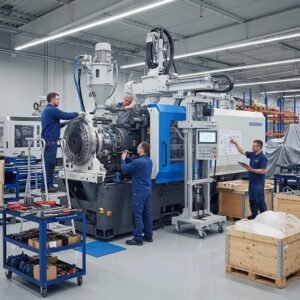
Plastic Machine Delivery and Logistics to Nigeria
Plastic Machine Deli
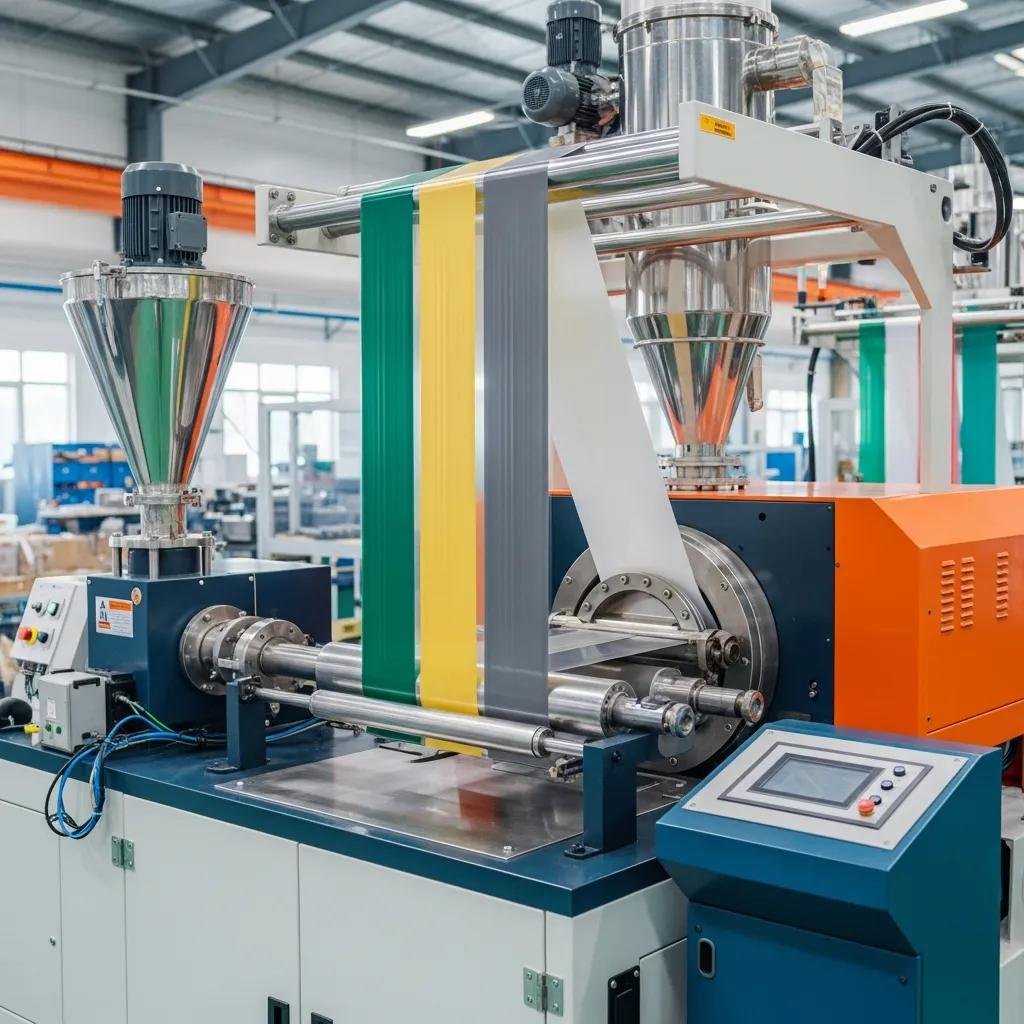
A 3 layer co-extrusion blown film machine produces plastic film by simultaneously extruding three distinct polymer melts through a single die and inflating them into a controlled bubble that is cooled, collapsed and wound into rollstock. This process combines layers with different functions—structural strength, barrier protection and sealability—into one continuous film, enabling manufacturers to replace multi-step lamination with an integrated blown-film solution. Nigerian converters and packaging producers benefit from this approach because it improves packaging performance for food, liquids and industrial uses while enabling flexible use of HDPE, LDPE, LLDPE and specialty resins. This guide explains the co-extrusion mechanism, compares ABA and ABC configurations, maps common Nigerian applications, and shows how to evaluate price and return on investment within local operating conditions. Readers will also find practical information on sustainable resins, component-level maintenance, and the after-sales services typically available from experienced suppliers. Understanding these topics helps manufacturers select the right blown film line and optimize uptime, material yield and product value.
A 3 layer co-extrusion blown film machine is a blown film extrusion system where three extruders feed melt streams into a feedblock and die head to form a multilayer tubular film that is expanded as a bubble and cooled before winding. The mechanism relies on precise melt pressure control, synchronized screw speeds and an internal bubble cooling (IBC) system to set film gauge, clarity and layer adhesion, which together deliver targeted barrier and mechanical properties. The machine’s value lies in combining different polymers—such as a tough core and printable outer layers—so converters can tune film performance for seal strength, puncture resistance or printing quality. Below are three principal benefits that make 3-layer co-extrusion widely used in packaging and industrial films.
These operational advantages lead naturally into a closer look at how the co-extrusion process forms multi-layer film and the parts that make the system run smoothly.
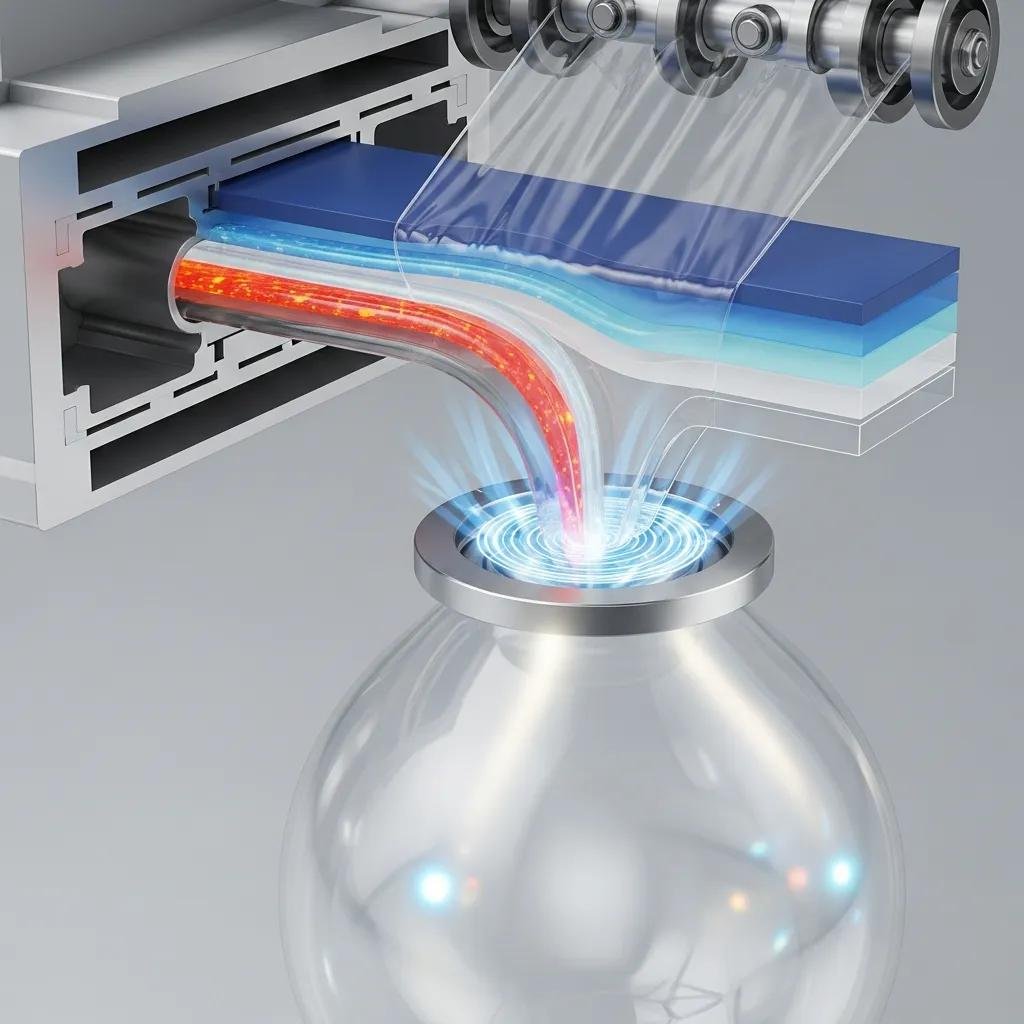
Co-extrusion creates multi-layer films by feeding three polymer melts from separate extruders into a feedblock or multi-manifold die where the streams are brought together in a controlled arrangement before exiting the die as concentric layers. Melt flow uniformity, temperature control and rheological compatibility determine layer thickness, interlayer adhesion and final film clarity, so process engineers monitor screw speeds, melt pressure and die gap closely. The die head design and the IBC system influence bubble stability and cooling rate, which in turn affect crystallinity and barrier performance; for example, faster cooling preserves clarity while slower cooling can improve stiffness in semicrystalline resins. Understanding these interactions helps manufacturers choose resin combinations and processing windows that meet target film properties and downstream print or sealing requirements.
A 3 layer blown film line comprises multiple extruders, a feedblock/die head, internal bubble cooling (IBC) equipment, haul-off, winder and a process control system; auxiliary subsystems include screen changers, melt pumps and pellet feeders. Each extruder controls melt output and temperature for its specific layer, with screw diameter and L/D ratio influencing throughput and melt homogeneity. The die head and feedblock determine layer geometry and concentricity while the IBC system sets cooling and bubble stability, which directly affect film gauge and mechanical performance. Regular inspection of screen changers, bearings and winding tension reduces scrap rate and maintains consistent film quality. The next section compares the two most common 3-layer arrangements—ABA and ABC—and explains when each is preferable.
| Component | Function / Specification | Benefit / Example Parameter |
|---|---|---|
| Extruders | Deliver polymer melt; screw diameter and L/D ratio matter | Precise throughput control; common screw diameters 45–90 mm (example parameter) |
| Feedblock / Die Head | Shapes and layers melts into concentric film | Controls layer thickness and uniformity for barrier and print layers |
| IBC (Internal Bubble Cooling) | Regulates bubble cooling and blow-up ratio | Improved clarity and gauge control; stabilizes bubble for thin films |
| Haul-off & Winder | Collapses bubble and winds film into rolls | Accurate film layflat and roll tension for downstream converting |
| Screen Changer & Melt Pump | Remove contamination and ensure steady melt pressure | Reduces die lines and improves film surface quality |
This components table clarifies how each part contributes to film quality and operational reliability, and it prepares buyers to evaluate specification trade-offs when comparing machines.
ABA and ABC denote layer arrangements in a 3-layer film: ABA places the same polymer on both exterior layers with a different core, while ABC uses three distinct polymers for each layer to deliver separate functions. ABA is commonly chosen when symmetry is valuable for mechanical balance and when the outer layers need identical properties such as printability or sealability, whereas ABC enables a unique combination—e.g., a printable outer, a barrier middle and a sealable inner—offering maximum material flexibility. The trade-offs include cost versus function: ABC typically requires more careful material selection and processing control but can yield higher-performance films for demanding packaging. Below is a direct comparison table to help match configuration to application.
| Machine Type | Layer Structure | Typical Applications | Pros & Cons |
|---|---|---|---|
| ABA | A-B-A (outer layers identical) | General packaging, printable films, where symmetry improves mechanical stability | Pros: balanced properties, simpler material sourcing. Cons: less flexible for distinct layer functions |
| ABC | A-B-C (three distinct layers) | Barrier pouches, laminated replacement films, specialized seal/print functions | Pros: tailored layer function, optimized barrier/seal. Cons: more complex processing and material control |
| A-B-A with Tie | A-(Tie)-A | Filled-film or adhesive layers between incompatible polymers | Pros: enables incompatible polymer bonding. Cons: extra material cost for tie layer |
This comparison highlights how layer arrangement influences process complexity and final film functionality, leading into how extruder configurations further affect film properties.
Extruder configuration—screw diameter, L/D ratio, screw profile and speed—determines melt homogeneity, throughput and capacity to process filled or high-MFI resins, which in turn affects properties like stiffness and clarity. Larger-diameter screws with higher L/D ratios improve mixing and stabilization for recycled or filled resins, while smaller screws can be preferable for fast-melting sealant layers that require sharp temperature control. Temperature zones and melt pressure control influence crystallinity and bubble stability; for example, precise low-temperature zones help process heat-sensitive biodegradable resins. When specifying a line, select extruder sizes and control features that match intended resin blends and production rates to keep scrap low and film quality consistent.
Choosing between ABA and ABC depends on the end-use: ABA often suits commodity sacks, simple printed films and applications where outer layer uniformity aids converting, while ABC fits food sachets, barrier pouches and specialty films needing discrete barrier or seal layers. Local availability and cost of resins—HDPE, LDPE, LLDPE or specialty blends—affect the decision; for example, if barrier-grade resins are expensive or scarce, an ABA strategy using a cost-effective core with optimized outer layers may be preferable. Also consider downstream converting: if clients require high-quality print or metallization, specify outer layer formulations compatible with those processes. These application-driven choices determine the line configuration and expected process settings for reliable production.
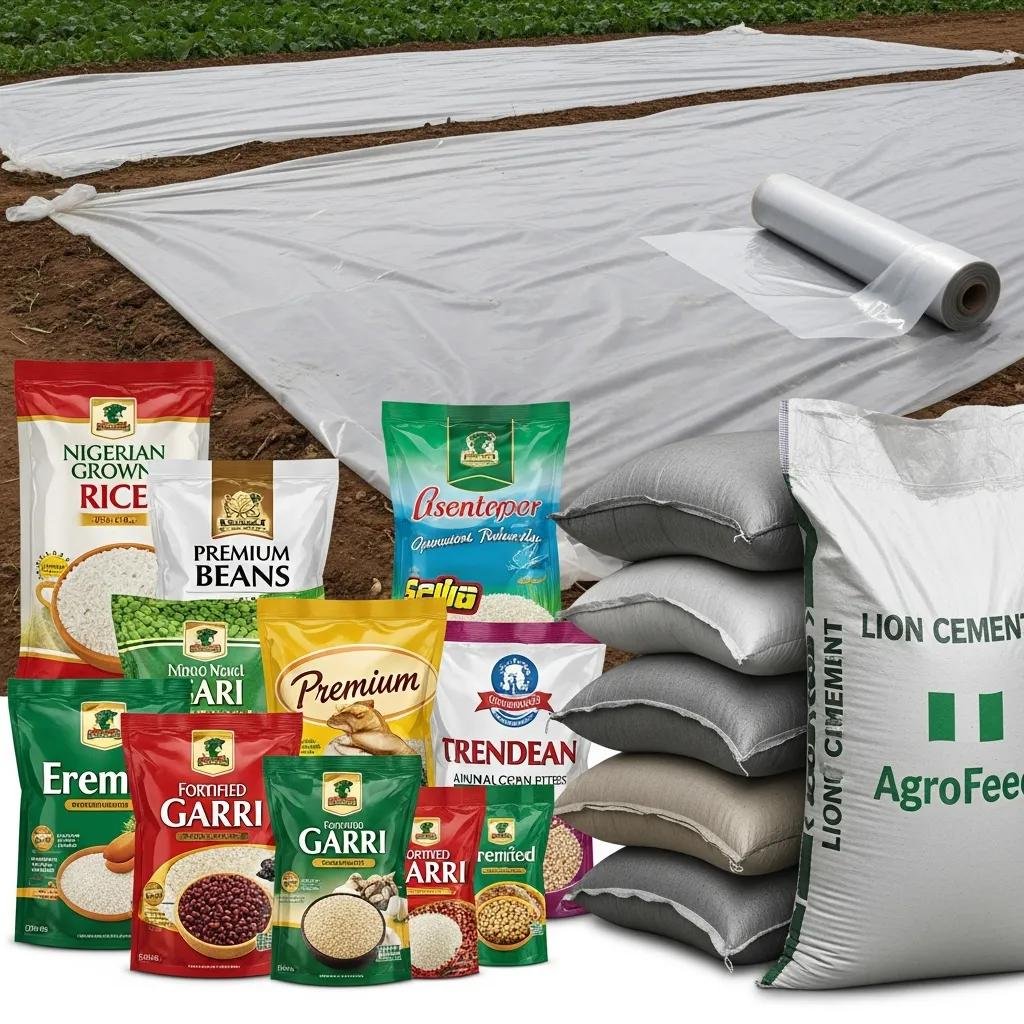
3-layer blown film machines address a wide range of Nigerian market needs including flexible food and liquid packaging, industrial sacks and agricultural films, delivering tailored barrier, strength and sealing properties. Film producers can supply water sachets, milk and liquid packaging, snack wrappers and stand-up pouches by selecting appropriate layer stacks and sealing layer formulations. In industrial and agricultural segments, the same technology produces shrink films, lamination substrates and mulch or greenhouse films where durability and UV resistance are essential. Below are the main application categories and examples of film types commonly manufactured.
These application categories connect directly to material choices and machine settings, which we examine in the next subsection focused on food and liquid packaging requirements.
For food and liquid packaging, 3-layer films combine a printable outer layer, a functional barrier or puncture-resistant core and a heat-sealable inner layer that meets seal strength and food-safety needs. Typical stacks might use LLDPE or LDPE for seal layers, a modified PE or EVOH for oxygen barrier where needed, and HDPE or filled blends for mechanical durability; layer adhesion and migration limits must comply with local food-contact expectations. Process control—tight gauge variation, consistent cooling and accurate winding—ensures reliable pouch forming and sealing, while printability and surface treatment of the outer layer support branding. Manufacturers should specify testing for seal strength and oxygen/moisture transmission to ensure performance in distribution conditions.
Industrial and agricultural applications leverage 3-layer lines to make shrink film, lamination substrates, mulch and greenhouse films, each requiring distinct properties like shrinkability, tear resistance, or UV stabilization. Processing filled resins with CaCO3 or other fillers increases stiffness and reduces cost per kg but demands extruder mixing capability and modified die designs to avoid die lines. Shrink films require controlled orientation and cooling to achieve consistent shrink ratios, while greenhouse films need additives for UV protection and long-term clarity. Selecting material grades and extrusion parameters tailored to these end-uses enables local manufacturers to meet diverse market demands.
Evaluating price and ROI requires examining CAPEX and OPEX drivers—machine cost, shipping/import, installation, energy, labour, raw materials and spare parts—then projecting incremental profit based on throughput, yield and product margins. Key performance metrics include kg/hr throughput, energy consumption per kg, scrap rate and effective selling price per kg of finished film. A simple ROI checklist helps structure this evaluation and an example calculation below shows payback logic for Nigerian production conditions.
| Cost Category | Unit / Frequency | Example Value or Impact |
|---|---|---|
| Machine CAPEX | One-time | Significant; varies by specification and automation level |
| Installation & Commissioning | One-time | Includes on-site setup and training; budget as percent of CAPEX |
| Energy | Monthly / per kg | Major OPEX driver—monitor kWh/kg for efficiency comparisons |
| Labour | Monthly | Depends on automation; higher automation lowers labour per kg |
| Raw Materials | Per kg | Biggest recurring cost; material selection affects margin heavily |
| Spare Parts & Maintenance | Annual | Budget for wear parts and occasional die servicing |
This EAV table clarifies the main cost buckets that determine total cost of ownership and ROI. Next, we examine which technical factors most influence machine price.
Machine price depends on extruder size and number, die head complexity, level of automation, IBC sophistication and the degree of customization required to handle special resins or filled compounds. Higher automation—servo-driven haul-offs, automatic gauge control and advanced PLC/HMI systems—increases CAPEX but reduces labour and scrap, improving long-term OPEX; die heads with advanced layer distribution or melt pumps add to upfront cost but improve product consistency. Shipping, import duties and local installation logistics also add to the landed cost in Nigeria. Buyers should weigh specification upgrades against expected productivity gains to find the optimal balance for their production targets.
A practical ROI formula is: Payback Period = Total CAPEX ÷ Annual Net Cash Flow from Machine, where Annual Net Cash Flow = (Annual Production kg × Contribution Margin per kg) − Annual OPEX. Gather inputs such as expected production rate (kg/hr), operating days per year, average selling price and material costs to compute realistic payback. For sensitivity, test scenarios altering scrap rate, energy cost and material price to see how payback changes; a reduction in scrap by 1-2% or improved energy efficiency can materially shorten payback. This approach helps procurement teams compare offers on both technical and financial terms.
| Metric | Description | Typical Sensitivity Impact |
|---|---|---|
| Throughput (kg/hr) | Production capacity per hour | High—directly scales revenue |
| Scrap Rate (%) | Percentage of off-spec film | High—reduces usable output and margin |
| Energy (kWh/kg) | Energy consumed per kg | Medium—affects OPEX and margin |
| Automation Level | Degree of process automation | Medium—higher CAPEX, lower labour costs |
| Material Cost (NGN/kg) | Raw material expense | High—largest recurring cost |
These metrics guide ROI modeling and promote informed negotiation with suppliers by focusing on the factors that change lifetime cost.
Within technical and commercial evaluation, some buyers prefer to work with suppliers offering reliable local support and defined warranty and delivery terms. China Evergreen Machinery Co., Ltd. (also known as Kingdom Machinery) positions itself as a global manufacturer and supplier of plastic film and bag production equipment, with extensive production capacity and R&D, and service coverage that includes Nigerian cities. Their UVPs—100% final inspection, a stated two-year warranty on timer switches, competitive pricing and standard lead-times such as sample delivery in three days and bulk shipping in 15–20 days for standard builds—can be factored into the landed cost and ROI calculation. Considering these vendor guarantees alongside technical specifications helps reduce risk in procurement.
Modern 3-layer blown film lines can process blends of recycled content and biodegradable polymers by adapting extruder mixing, temperature profiles and die design to the material’s thermal sensitivity and rheology. Compatible sustainable materials include blends with recycled PE regrind, and combinations incorporating biodegradable polymers like PLA or PBAT when process conditions and downstream application permit. Processing such resins often requires gentler temperature ramps, modified screw elements for low-shear mixing and additives to improve flexibility or interlayer adhesion. The environmental benefits for Nigerian businesses include reduced virgin resin usage, potential cost savings from recycled content, and marketing differentiation for eco-conscious brands.
Common sustainable options for 3-layer co-extrusion include blends of recycled HDPE/LDPE with virgin PE for cost and property recovery, and formulations that incorporate PBAT or PLA to increase biodegradability where compostable claims are appropriate. PLA tends to be more brittle and sensitive to processing temperatures; PBAT imparts flexibility and can be co-extruded as a sealant or tie layer when compatible. Additives such as plasticizers, compatibilizers and processing stabilizers help blend recycled or biodegradable resins without severe loss of mechanical properties. Careful quality control on incoming recycled feedstock—checking ash, moisture and contamination levels—is essential to maintain consistent production.
Adopting recycled and biodegradable films can reduce reliance on virgin resin imports, lower material costs and support waste diversion goals, while creating product differentiation that appeals to environmentally conscious consumers and brands. Operationally, improving yield and reducing scrap by optimizing process parameters directly reduces raw-material consumption per finished roll. Regulatory and market trends increasingly favor sustainable packaging, so offering recyclable or partially biodegradable films can open new client segments. These benefits create both cost and reputational value for manufacturers who correctly implement sustainable extrusion practices.
After-sales support for blown film machinery typically covers installation and commissioning, operator and maintenance training, spare parts supply, warranty coverage and remote or on-site technical assistance to ensure uptime and consistent film quality. Local installation and commissioning shorten ramp-up time and ensure the machine is calibrated for local power, resin grades and operator skills. Suppliers with local presence or partners in major Nigerian cities can provide faster spare-parts delivery and responsive troubleshooting to minimize production interruptions. Below is a list of common after-sales services that buyers should confirm before purchase.
These services reduce initial risk and accelerate the production learning curve, leading into a closer look at how on-site training improves machine performance.
Local installation and hands-on training ensure that operators understand process control, die adjustments and preventive maintenance routines, which accelerates the ramp-up to target OEE and reduces early scrap. Training modules often include start-up and shutdown procedures, troubleshooting common defects (gauge variation, bubble instability), and routine maintenance tasks for gearboxes, bearings and screen changers. Measurable benefits include fewer unplanned stops, reduced scrap during the first production months and faster problem resolution by local teams. Suggested training durations typically span several days of on-site instruction followed by remote follow-up sessions to reinforce best practices.
A disciplined maintenance program includes daily checks of melt temperature and pressure, weekly inspection of screen changers and belts, and monthly checks of die concentricity and bearing wear, which together prevent common issues like die lines, bubble collapse and gauge variation. Troubleshooting often begins with systematic checks: verify extrusion temperatures and screw speeds, inspect feedblock and die for contamination, and confirm IBC airflow and cooling rings are operational. Keeping a stocked inventory of critical spare parts—screen packs, heater cartridges, bearings—reduces downtime when wear parts fail. When issues exceed in-house capability, prompt technical support from the supplier or local service team minimizes prolonged production loss.
China Evergreen Machinery Co., Ltd. (also known as Kingdom Machinery) emphasizes post-sale reliability through local service coverage in Nigerian cities, one-stop customization, and manufacturing capacity backed by multiple production lines and testing equipment. Their stated quality controls, warranty specifics and sample/bulk delivery timelines are practical considerations to include when negotiating service-level agreements. Prospective buyers should request clear SLAs covering installation, training scope and spare-parts lead times and confirm local service coverage before finalizing procurement.
Plastic Machine Deli
Comprehensive Guide
Plastic Machine Succ
Find Plastic Machine