
Plastic Machine Delivery and Logistics to Nigeria
Plastic Machine Deli
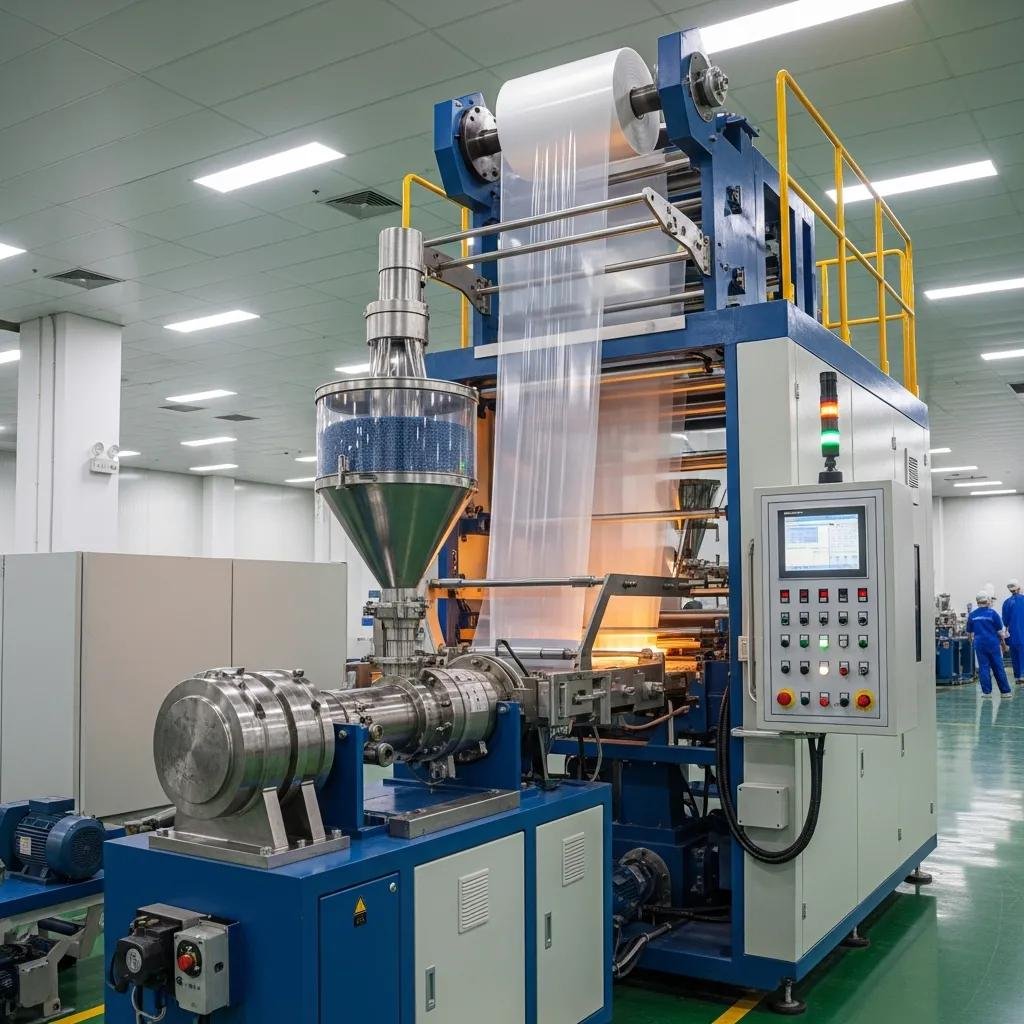
High-density polyethylene (HDPE) blown film machines are extrusion systems that melt HDPE resin and form a continuous tubular film used for bags and industrial packaging, delivering consistent thickness and mechanical strength required by Nigerian converters. This guide explains how HDPE blown film extrusion works, what machine types are available in Nigeria, and which technical specifications matter when matching capacity to product requirements. Buyers and operators will learn step-by-step process controls, material compatibility notes for HDPE and related resins, common applications such as t-shirt bags and industrial sheeting, and the procurement considerations that affect price and time-to-production. The article maps machine categories, the extrusion process, applications and benefits, technical specifications and feature comparisons, cost drivers and buying checklists, and supplier evaluation focused on the Nigeria market. Throughout, keyword-relevant topics like hdpe blown film extrusion, hdpe film blowing extruder machine, and film blowing machine installation cost are integrated to assist sourcing teams, production managers, and technical operators. After explaining technical and operational aspects, the guide notes supplier options and what to request when getting quotes in Lagos, Kano, Ibadan, or Benin City.
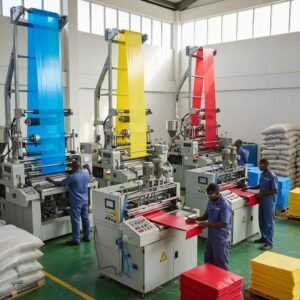
An HDPE blown film machine converts polymer pellets into film via extrusion and air inflation; main machine categories differ by layer configuration, speed, and material compatibility, which determine output, film properties, and suitable end-uses. Choosing between single-layer, multi-layer, high-speed, and biodegradable-capable lines hinges on required film performance, printing and lamination needs, production throughput, and cost constraints. Single-layer lines are simpler and lower-cost for commodity bags, multi-layer or co-extrusion lines provide barrier or printability enhancements, high-speed lines prioritize throughput for large-volume converters, and biodegradable-capable machines are tuned to process compostable resins or recycled blends. Below is a quick comparative list to guide category selection, followed by a brief note about suppliers offering these configurations in Nigeria.
Manufacturers and suppliers active in the Nigeria market offer examples of these categories, and buyers can request model catalogs or sample specifications to match product targets.
The next subsections compare single-layer against multi-layer designs and explain features specific to high-speed and biodegradable extrusion systems.
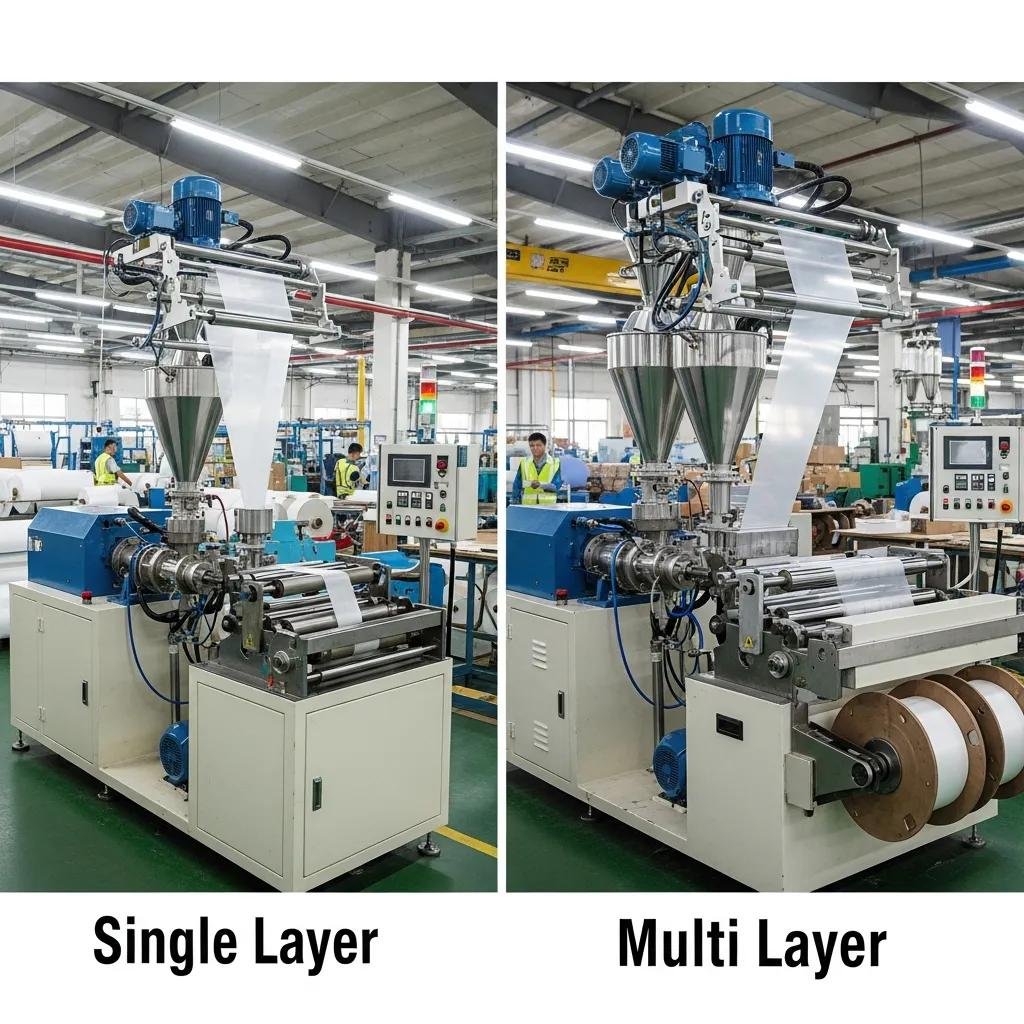
Single-layer blown film extruders use one extruder and die to produce a homogeneous film; their mechanism is straightforward—single melt path, single die lip—resulting in simpler control and lower capex but limited ability to optimize surface and barrier properties. Multi-layer or co-extrusion plants combine two or more extruders with a co-extrusion die to produce layered films (for example ABA or ABC configurations) so each layer can be formulated for strength, printability, or sealability, providing improved mechanical and barrier performance. Practically, multi-layer films reduce material usage by placing low-cost core layers and using expensive polymers only on functional surfaces, which lowers cost per performance in many bag and pouch applications. For buyers deciding between them, single-layer is appropriate for low-spec commodity bags and smaller budgets, while multi-layer is suited to branded retail bags, lamination-ready films, and applications requiring specific barrier or sealing characteristics.
High-speed blown film machines are engineered for elevated screw RPM, robust gearbox and motor capacity, advanced cooling air rings and larger-diameter die heads, plus precision winding to handle faster haul-off rates without bubble instability; these features increase throughput but require more rigorous maintenance and energy planning. Machines built for biodegradable or recycled resins focus on gentle melt handling, tighter temperature control, degassing or venting options, and sometimes modified screw geometry to avoid thermal degradation of sensitive polymers; operators must manage melt temperatures and residence time carefully to preserve material properties. Trade-offs include higher initial investment and potentially higher energy usage for high-speed lines, versus the processing discipline and potential yield variability when running recycled or biodegradable blends. Understanding these trade-offs helps operators balance CAPEX, OPEX, and finished-film performance before selecting a machine.
The HDPE blown film extrusion process transforms polymer pellets into a continuous film through a controlled sequence of melting, extrusion through a die, inflation to form a bubble, cooling, collapse, and winding; precise control of key parameters directly affects film gauge uniformity and mechanical properties. Mechanistically, the extruder melts resin and pushes molten polymer through a circular die; compressed air inflates the extrudate into a bubble whose blow-up ratio and freeze-line height determine film orientation and thickness. Cooling—via air rings—and haul-off speed set the final film dimensions and crystallinity, while winding packages the finished tube or lay-flat film for conversion. Understanding each step and its process variables enables operators to troubleshoot defects like gauge bands, gels, or poor sealing, and to optimize runs for different HDPE, LLDPE, or blended formulations.
Different process steps require monitoring of temperature, screw speed, blow-up ratio, and freeze-line location to maintain film quality; the table below summarizes typical control ranges and why they matter.
This table outlines key process steps and control parameters for HDPE blown film extrusion.
| Process Step | Key Parameters | Typical Range / Notes |
|---|---|---|
| Melting & feeding | Barrel temp zones, screw speed | Barrel zones variable by resin; screw speed affects melt pressure and throughput |
| Extrusion through die | Melt pressure, die lip gap | Stable melt pressure and correct lip gap ensure even flow and gauge control |
| Inflation (bubble) | Blow-up ratio (BUR), internal air temp | BUR 1.5–3.0; controls biaxial orientation and film width |
| Cooling | Air ring temperature and flow, freeze-line height | Proper cooling stabilizes bubble and sets crystallinity |
| Haul-off & winding | Haul-off speed, nip tension, winder type | Controls final thickness and roll quality; too high speed leads to gauge variation |
Control of these parameters reduces defects and improves yield, and operators should link observed defects back to the relevant parameter set. The next subsection breaks these steps down into actionable checks and typical operator ranges for common issues.
Operators should follow a sequence of controlled checks: verify correct resin drying and melt temperature, set screw speed to target throughput, confirm die concentricity and lip gap, inflate bubble to target blow-up ratio and maintain a consistent freeze-line, adjust air-ring cooling for bubble stability, and use appropriate haul-off and winding tensions to prevent telescoping or wrinkles. Typical troubleshooting steps include lowering melt temperature if degradation appears, reducing screw speed when melt pressure spikes, and fine-tuning the air ring to shift freeze-line height for better gauge control. Safety and regular maintenance—checking heaters, thermocouples, and lubrication—prevent unplanned downtime and preserve product quality. These practical operator checks ensure consistent film properties and feed naturally into material compatibility choices in the next subsection.
HDPE blown film machines commonly process HDPE resins but are also compatible with LDPE, LLDPE, and selected recycled and biodegradable blends when the screw design, temperature control, and die configuration match the resin characteristics; each polymer requires tuned melt temperature and cooling profiles for optimal film properties. HDPE produces stiffer, stronger films suited for t-shirt bags and heavy-duty sacks, LLDPE and LDPE enable higher elongation and better sealability for stretchable applications, and blends with recycled PE or biodegradable polymers may need lower shear screws and controlled residence time to avoid degradation. Material selection impacts final film clarity, sealing temperature, and mechanical strength; therefore, buyers should specify intended end-use performance so suppliers can recommend screw geometry and die heads that match the resin portfolio. The following section examines primary applications and how blown film technology serves each market need.
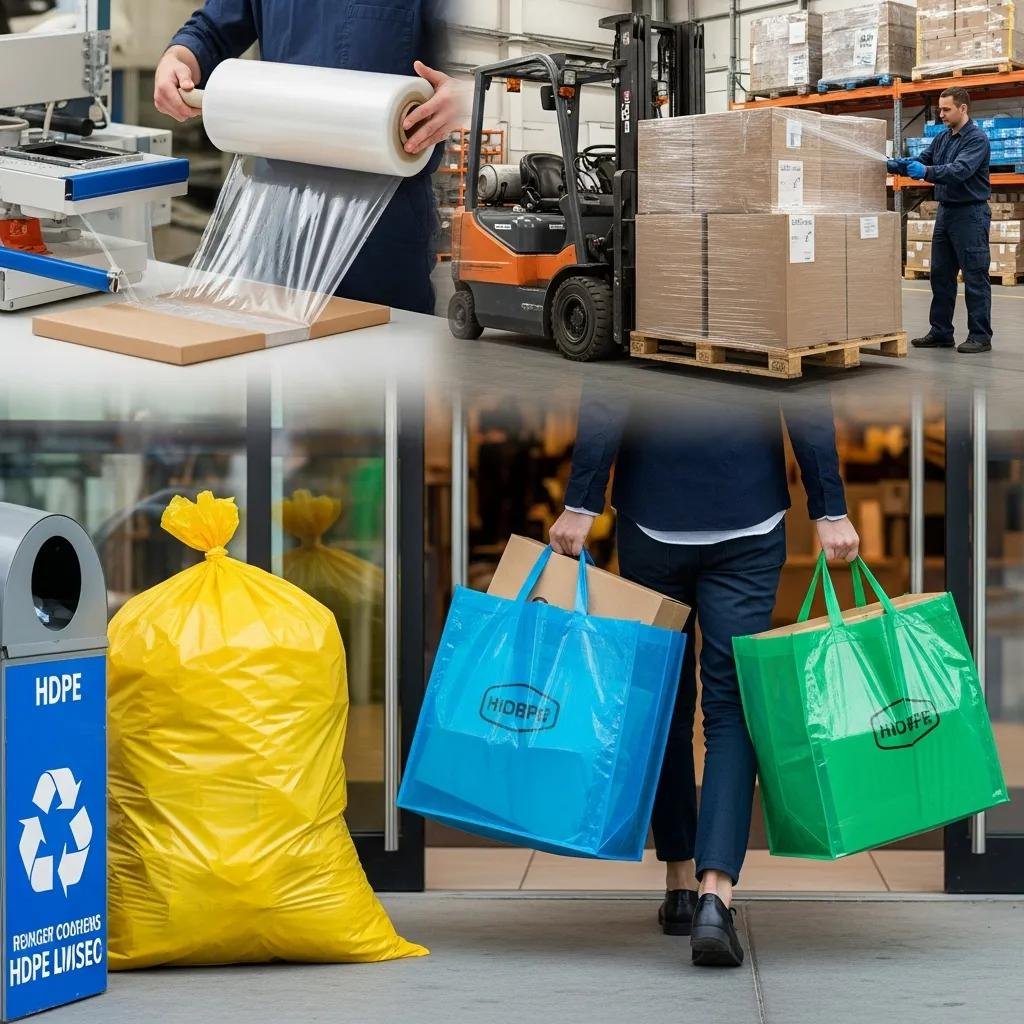
HDPE blown films serve a wide range of applications from retail t-shirt bags and shopping bags to heavy-duty industrial packaging, offering predictable strength, chemical resistance, and cost-effective production for varied film thicknesses and widths. The blown process yields a balanced mechanical profile due to biaxial orientation, enabling uniform gauge and good tensile properties that convert well into finished bags and wraps. For converters, the ability to produce narrow to wide films with controlled thickness makes blown film lines versatile across product families, while co-extrusion allows for surface layers optimized for printing or lamination. Below is a short list of typical applications followed by the benefits each use case extracts from blown film technology.
The blown film process delivers uniform thickness, good tensile strength, and economical scaling for different gauges, which together make it the preferred approach for many bag manufacturers. The next subsections detail typical film specs for bag types and compare blown film to cast film alternatives.
T-shirt bags and shopping bags typically use HDPE film in thickness ranges from 15 to 40 microns, with narrower widths for grocery bags and wider lay-flat films for larger shopping bags; printers often require corona-treated outer layers for ink adhesion. Garbage bags and industrial films use higher gauges and wider widths to achieve tear resistance and load-bearing capacity, and converters may laminate or print depending on branding needs. Conversion to finished products involves cutting, sealing, and handle formation using bag-making machines tuned to the film thickness and heat-seal properties. When sourcing film, specify target thickness, print requirements, and recyclability to ensure the blown film line and post-processing equipment meet production goals.
Blown film technology produces films with more uniform mechanical properties and better orientation than cast film, resulting in improved strength and puncture resistance that benefits bag performance; the tubular nature of blown film also simplifies lay-flat production and multi-roll winding. Economically, blown film lines can be more efficient for producing wide gauge ranges and are generally more flexible for quickly changing product formats, reducing time-to-market for new bag sizes. Compared with cast film, blown film offers superior toughness but may have slightly lower optical clarity; converters choose based on the trade-off between mechanical performance and visual attributes. Understanding these advantages helps buyers determine which extrusion approach aligns with product priorities and downstream conversion requirements.
Technical specifications determine how a blown film machine performs in throughput, film width, and thickness control; key attributes include screw diameter and L/D, output in kg/hr, die head type, film width range, film thickness range, power consumption, and automation level. Buyers evaluating machines should map these specs to production targets—larger screw diameters and higher motor power increase throughput, while die head design and air-cooling capacity influence gauge uniformity and maximum stable width. Features such as PLC control, intelligent temperature controllers, corona treatment stations, and advanced winding systems improve consistency and reduce operator dependency. The EAV table below compares sample model-level attributes to help buyers compare options quickly and to highlight where customization is commonly offered.
The table compares representative machine models and their core technical attributes for buyer comparison.
| Model (Example) | Screw Diameter / L:D | Output (kg/hr) | Film Width Range | Film Thickness Range |
|---|---|---|---|---|
| Model A (single-layer) | 55 mm / 30:1 | 80–120 kg/hr | 300–800 mm | 10–60 µm |
| Model B (co-extrusion 3-layer) | 65 mm / 30:1 | 150–250 kg/hr | 400–1200 mm | 15–120 µm |
| Model C (high-speed) | 75 mm / 30:1 | 300–600 kg/hr | 600–1600 mm | 20–200 µm |
This table highlights how screw size and model type map to output and film ranges; many suppliers offer customization of screw geometry, die head type, and automation level to match production needs. After selecting target specs, buyers should confirm supplier support for commissioning, spare parts, and training to ensure consistent performance.
Output capacity correlates strongly with screw diameter and L/D ratio; larger screws and higher torque motors increase melt throughput and enable higher kg/hr production. Die head diameter and die gap determine the maximum stable film width and initial melt distribution, while haul-off speed and blow-up ratio set final thickness and width via stretching and orientation control. Cooling efficiency and winding system precision influence ultimate gauge uniformity and roll quality; insufficient cooling can produce unstable freeze-lines and lead to gauge variation. Understanding these attribute relationships helps buyers specify the mechanical and electrical characteristics needed to reach target throughput and film dimensions.
Automation—PLC temperature control, automatic film centering, and tension-regulated winders—reduces operator variability, shortens set-up times, and improves first-pass yield, providing clear operational ROI in labor savings and consistent quality. Energy-efficient components such as high-efficiency motors, zoned heating control, and optimized screw designs reduce kW/hr consumption and lower operating costs over the machine lifecycle. Remote monitoring and diagnostics combined with supplier support can shorten downtime and inform preventive maintenance decisions. Buyers should evaluate automation features against expected production runs and labor skills to balance CAPEX with long-term OPEX savings.
Machine cost in Nigeria depends primarily on machine type (single-layer vs multi-layer vs high-speed), capacity, automation level, die/head configuration, and customization needs; additional cost drivers include shipping, installation, training, spare parts, and local taxes or import fees. Rather than a single sticker price, budget expectations should be based on a breakdown of cost components so buyers can prioritize features that impact production and payback. Below is a cost-component table that clarifies typical items buyers must budget for, followed by a practical buyer checklist and a call-to-action to request tailored quotations that reflect local logistics and customization.
This table breaks down major cost components and what each typically covers to guide procurement planning.
| Cost Component | What It Covers | Typical Range / Notes |
|---|---|---|
| Base machine price | Core extruder, die, cooling ring, winder | Varies by model and capacity; primary CAPEX driver |
| Customization & tooling | Special dies, co-extrusion heads, control upgrades | Depends on co-extrusion layers and automation needs |
| Shipping & import | Freight, customs, handling to Nigerian ports | Regional logistics and duties affect total landed cost |
| Installation & commissioning | On-site setup, training, test runs | Essential for first production; supplier SLA matters |
Buyers should request a full quote that itemizes these components to compare offers accurately and understand total cost of ownership. Next, practical regional pricing guidance and after-sales expectations help refine the procurement decision.
Exact prices vary with specification, but buyers in Lagos, Kano, Ibadan, and Benin City should expect total landed and commissioned costs to reflect the machine category and customization level; single-layer commodity lines will be at the lower end of the budget spectrum, while multi-layer and high-speed plants command higher CAPEX. Local logistics, import duties, and installation complexity can add materially to the machine price, and buyers are advised to request formal quotations that include shipping, import handling, installation, commissioning, and training. When obtaining quotes, specify required film width, thickness range, intended resins, and expected daily throughput so suppliers can provide comparable proposals that reflect regional delivery and commissioning realities.
Buyers should verify after-sales services including installation and commissioning support, spare parts availability, remote and on-site technical assistance, and warranty coverage terms for electrical and mechanical components; SLA commitments for technician response time and spare-part lead times are critical in Nigeria. Confirm whether the supplier performs a final inspection before shipment and what warranty elements are covered; investigate availability of local technicians, training packages, and preventative maintenance plans. A clear agreement on spare parts supply chains and remote diagnostic capabilities reduces production risk and shortens time-to-recovery in case of faults.
China Evergreen Machinery Co., Ltd. (operating as Kingdom Machinery in Nigeria) positions itself as a manufacturer and supplier of plastic film and bag production equipment, offering HDPE blown film machines alongside high-speed and biodegradable blown film extrusion solutions; their messaging emphasizes practical buyer benefits that reduce risk and accelerate production. The company’s stated strengths include simple operation, perfect performance, easy maintenance, timely after-sales service, and quality assurance processes. They highlight a 100% final inspection regime, a two-year warranty on timer switches, an R&D team that supports customization, one-stop service options, competitive pricing, and delivery timelines for standard versus customized machines—points that help Nigerian buyers assess supplier reliability.
These attributes can reduce procurement friction and provide clearer expectations during installation and ramp-up, and the following subsections summarize how the company ensures quality and what unique value propositions it promotes.
China Evergreen states that each machine undergoes 100% final inspection before shipment and that certain components, such as timer switches, carry a two-year warranty, which together provide a baseline for quality assurance and post-sale protection. The company also highlights an R&D team and customization service that enable tailored solutions and typically lists delivery windows depending on standard versus custom builds to help buyers plan lead times. Fast delivery and timely after-sales service are promoted as practical benefits for Nigerian customers, with on-the-ground service presence emphasized in major cities to improve responsiveness during installation and commissioning.
China Evergreen’s stated UVPs include one-stop service and customization, competitive pricing, global installation experience, and commitments to quality control and after-sales support; these claims aim to reduce buyer risk and shorten the path from purchase to production. While specific customer testimonials or Nigeria case studies should be requested directly from the supplier, prospective buyers can ask for evidence of prior installations and service records in Lagos, Kano, Ibadan, or Benin City to verify regional experience. To move forward, request detailed quotations, sample specifications, and case references to confirm that the machine, warranty, delivery timelines, and post-sale support meet your operational requirements.
This completes the structured guide; for procurement actions, prepare specification sheets and production targets to send with your request-for-quote so suppliers can provide precise proposals tailored to your Nigeria operation.
Plastic Machine Deli
Comprehensive Guide
Plastic Machine Succ
Find Plastic Machine